Fixed-Point Catalogue
Explore all 19 fixed-point classes from the coherence vacuum through Floquet limit cycles. View field panels, convergence diagnostics, and stability verdicts.
Interaction Chamber
Five animated simulations: vortex–antivortex annihilation, same-charge repulsion, soliton collision, dark-stripe × vortex composite, and breathing mode impurity.
Floquet Limit Cycles
Periodic orbits of the GPE phase flow: breathing modes, Rabi oscillations, and vortex precession. Protected by Floquet theory rather than topological winding.
Coulomb Fixed Points
Hydrogen 1s and 2s orbitals as GPE fixed points in a Coulomb potential. Bogoliubov spectrum, BdG stability gap, and Rydberg ladder.
Feynman Rules & Diagrams
Perturbative series decomposition of all five interaction scenarios. GPE action, Bogoliubov propagators, vortex–phonon vertex, and diagrammatic analogues of \(e^+e^-\) annihilation, Coulomb repulsion, and elastic soliton scattering.
What is Coherence Field Theory?
Coherence Field Theory (CFT) proposes that fundamental particles are topological or spectral fixed points of a nonlinear Schrödinger field. The field obeys the Gross–Pitaevskii equation (GPE):
A fixed point \(\psi^*(\mathbf{r})\) is a time-independent solution (up to a global phase \(e^{-i\mu t/\hbar}\)) to which nearby field configurations converge. Different fixed-point types — characterised by their topological winding number \(n\), spatial structure, and stability spectrum — correspond to different particle species.
The topological protection of vortex fixed points (\(\pi_1(S^1) = \mathbb{Z}\)) is the coherence-field analogue of lepton-number conservation. The Magnus force between vortices acts as an effective electrostatic interaction: same-sign winding repels, opposite-sign winding attracts. Pair annihilation (\(n{=}+1\) meets \(n{=}-1\)) releases the topological mass as phonon radiation — the coherence-field analogue of \(e^+e^- \to \gamma\gamma\).
Fixed-Point Gallery
click any entry for full detailInteraction Chamber
five animated interaction simulationsVortex–Antivortex Annihilation (IX1)
A \(n{=}+1\) vortex placed opposite a \(n{=}-1\) anti-vortex. Opposite winding numbers attract through the Magnus force, the cores merge, and the topological mass is converted to expanding phonon radiation — the coherence-field analogue of \(e^+e^- \to \gamma\gamma\).
The gestalt effect here is topological charge annihilation: neither vortex alone would decay; together they drive each other to the vacuum in finite time.
View full scenario →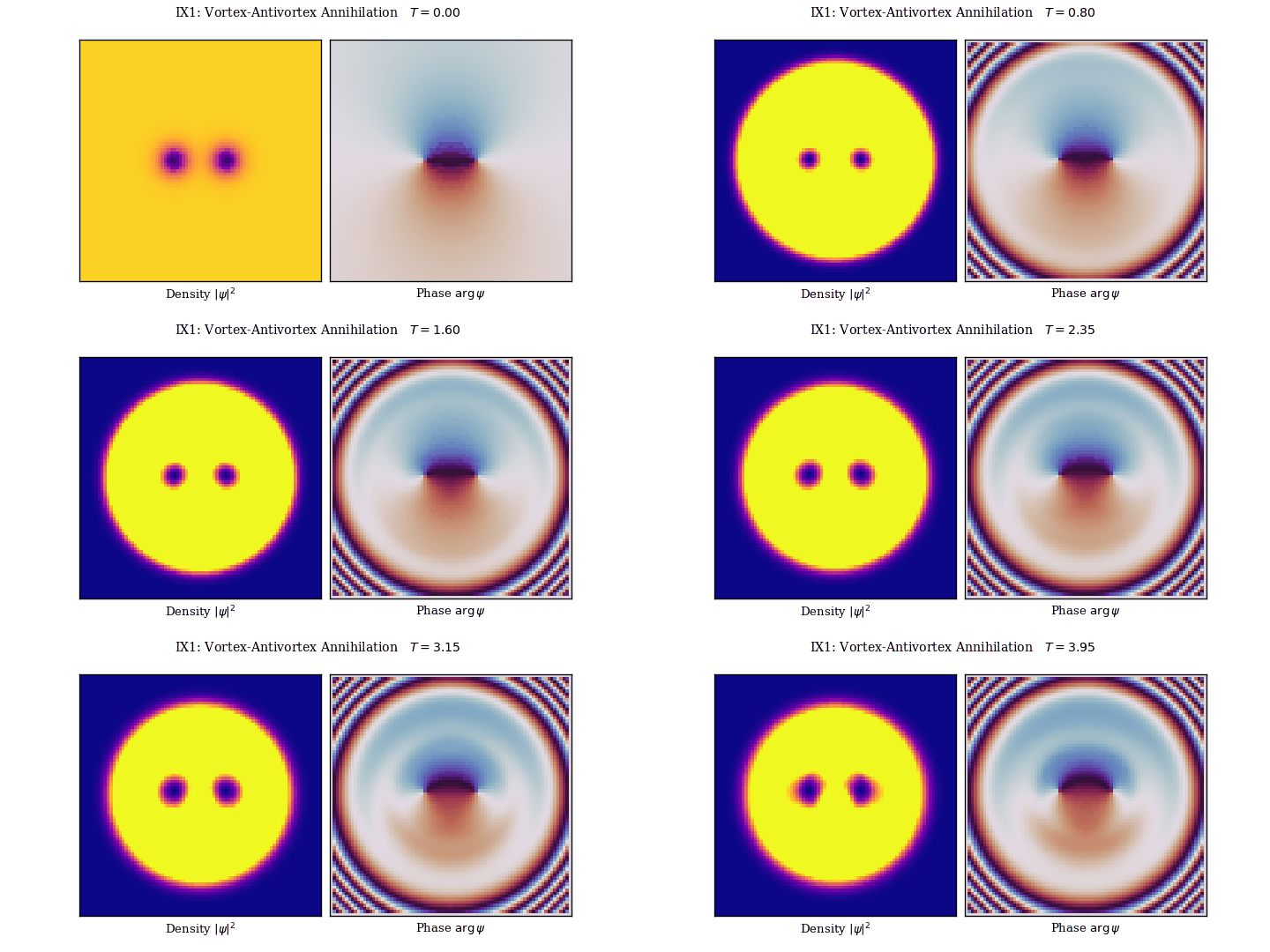
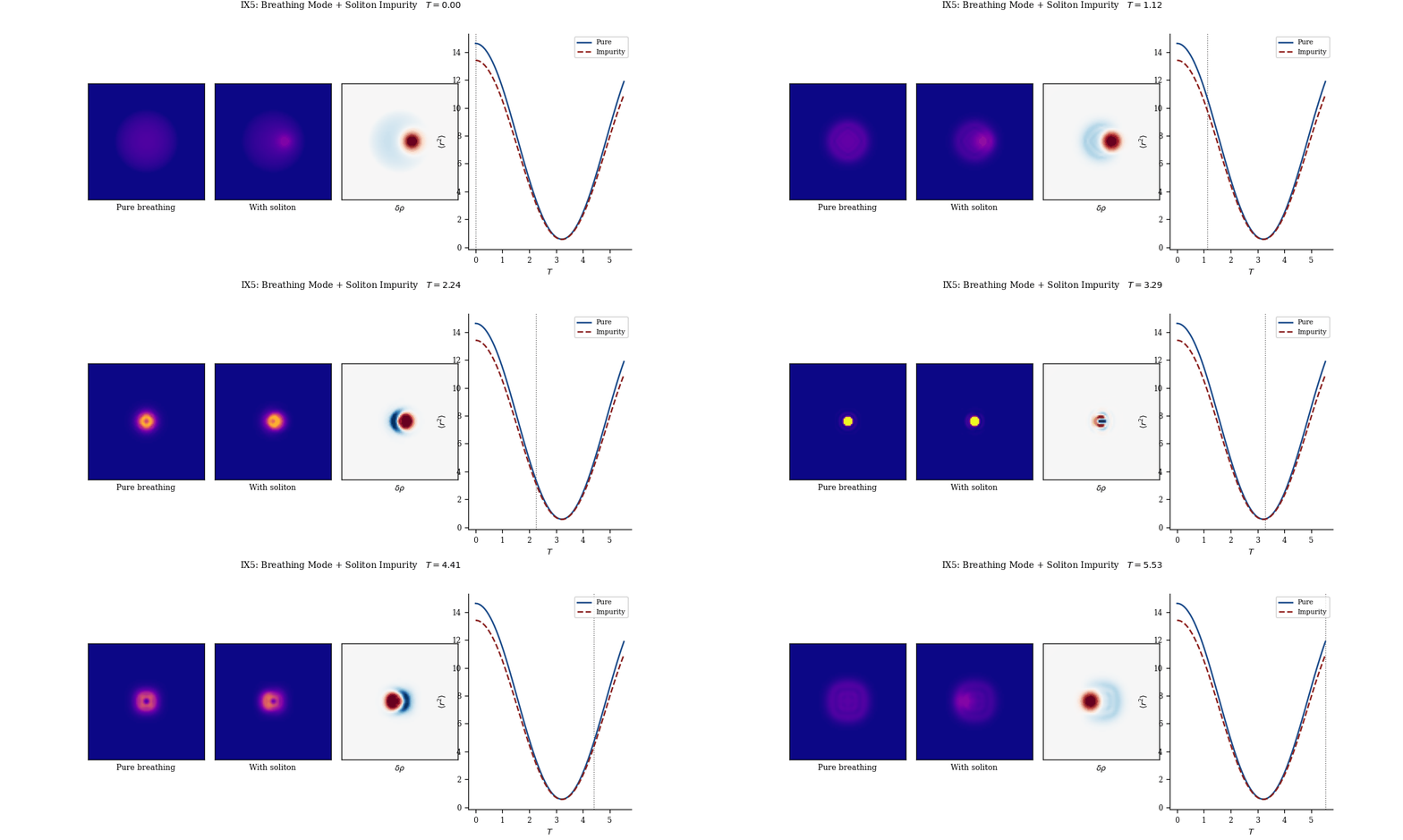
Breathing Mode × Soliton Impurity (IX5)
A Thomas–Fermi condensate in a harmonic trap, initialised with a radial breathing oscillation, is perturbed by a soliton impurity at radius \(r = 2.5\).
The Kohn theorem protects the breathing frequency \(\omega_B = 2\sqrt{\kappa}\) only for a rotationally symmetric state. The off-axis impurity breaks this symmetry, shifting and amplitude-modulating the breathing frequency in the \(\langle r^2\rangle(T)\) diagnostic — a phonon–impurity coupling effect.
View full scenario →Theory Documents
PDF reports on the underlying mathematicsFeynman Rules & Interaction Diagrams
Derives the complete perturbative Feynman rules for CFT from the GPE action — four propagators (free, Bogoliubov, phonon, soliton worldline) and four vertices (contact, condensate insertion, vortex–phonon Magnus coupling, external potential). Covers diagrammatic decomposition for all five canonical interactions: \(e^+e^-\) annihilation (IX1), Coulomb repulsion (IX2), soliton elastic scattering via the Yang–Baxter ladder (IX3), dark soliton \(\times\) vortex mixed topology (IX4), and breathing-mode self-energy shift (IX5).